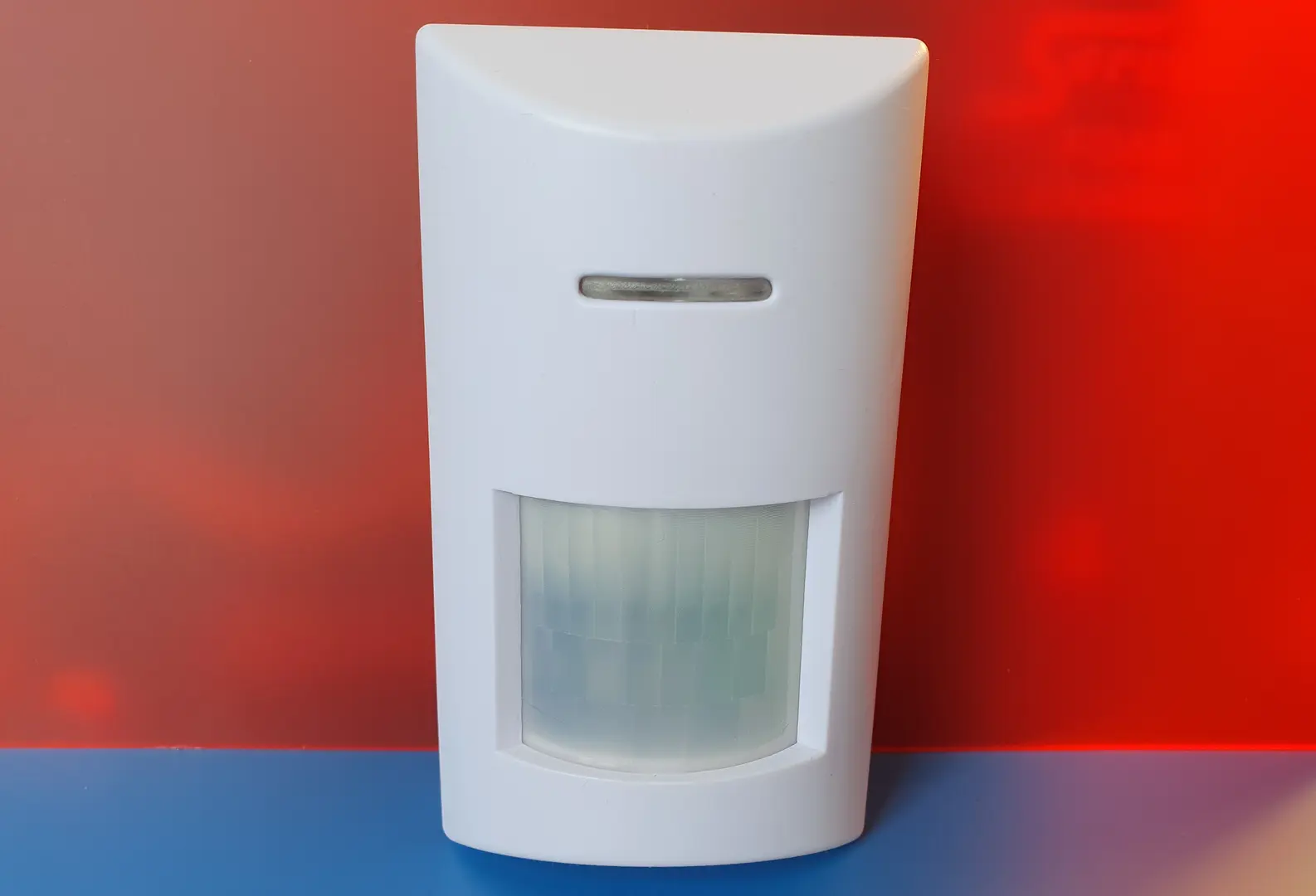
Well this was an absolute bargain for only £5.95 delivered. A PIR sensor with RF transmitter for use with a Keystone alarm system. There's no microcontroller, it's all through-hole components and based around a logic chip, an encoder, and a quad op-amp. It's quite a retro design even for late-2009, although it may have been designed much earlier, but it's certainly not what I expected when I opened the thing up!
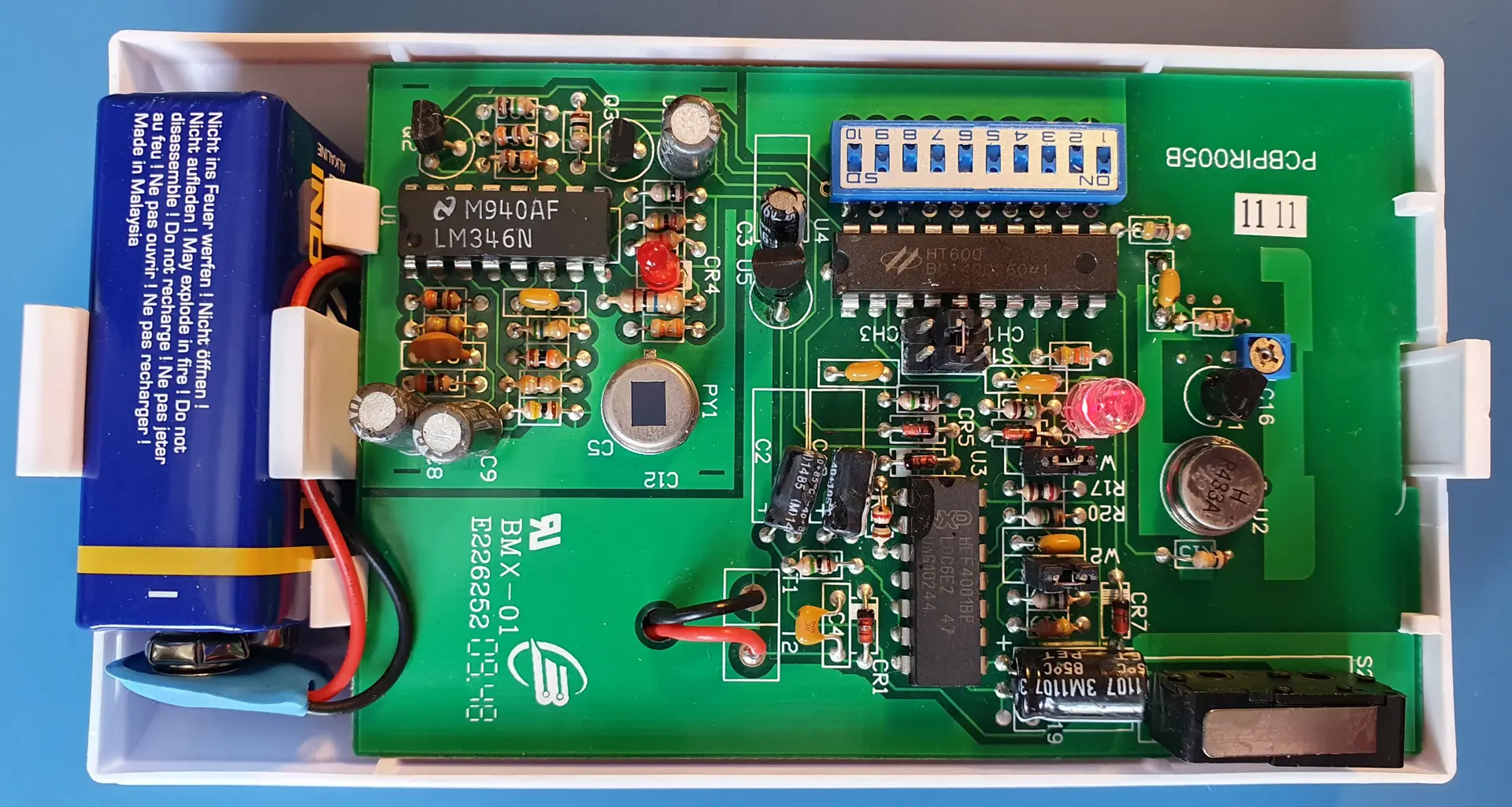
The pyroelectric infrared sensor PY1 is connected to circuitry forming an amplifier and window comparator, consisting of a quad op-amp and a selection of passive components. These are all contained in an isolated section away from the rest of the circuitry in the top-left of the PCB. Most PIR sensors these days use a cheap integrated circuit specifically designed for the application, which aren't as exciting to see!
The chip (U4) nearest the dip switch package is a Holtek HT600 encoder ‐ I read about them years ago, but have never actually had one to play with. When the transmission enable (TE) pin is set high, the address set by the ten position dip-switch package, and state of the five digital inputs, is encoded and sent out repeatedly as serial data on the data out (DOUT) pin, which goes directly to the RF transmitter section surrounding the 433MHz SAW resonator (U2) on the far-right.
The remaining chip (U3 / HEF4001) is a 4000 series logic quad NOR gate, which is used with some capacitors to form a timer for controlling the transmission duration once triggered. It also provides a three minute delay before the unit can be retriggered, without which it would transmit every time motion's detected, rapidly depleting the battery. There's a jumper link that disconnects the 'motion detected' LED for power saving purposes, it seems this LED is just to help with positioning during installation.
I imagine the security microswitch is wired to one of the HT600's inputs and the circuity driving the transmission enable pin, which activates an output on the receiver and triggers the alarm system's tamper circuit.
This sensor could be used with any 433MHz receiver connected to a microcontroller for decoding the data. Alternatively, a new PCB design could be made to fit the plastic enclosure, in which I'd reverse-engineer and replicate the analogue motion sensor section and replace the Holtek encoder, logic chip and associated passive components with a microcontroller. I'd either replicate the RF transmitter section or substitute it for my favourite AM transmitter module, the QAM-TX2-433 from RF Solutions.
This new PCB design could be made much smaller due to the reduced component count, and a replacement enclosure 3D printed to house it.